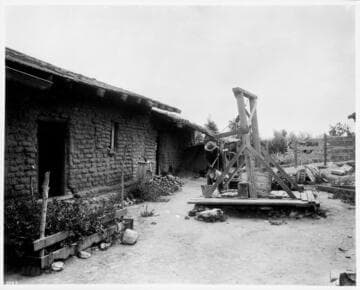
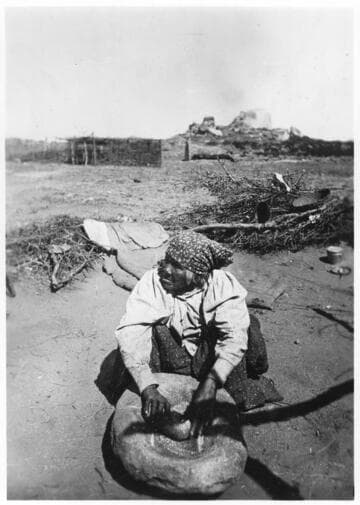
Visual Materials
Grinding on metate stone in patio of Aguilar hacienda at San Juan Capistrano
You might also be interested in
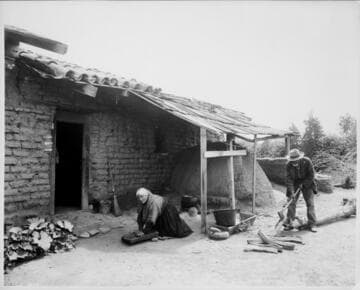
Coahuilla Indian woman grinding corn in stone mortar
Visual Materials
A view of an Indian woman squatting next to a stone mortor and grinding corn. Behind her is a brush lean to.
photCL Pierce 01768
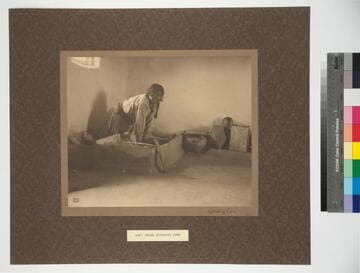
Grinding Corn. Hopi
Visual Materials
A woman kneeling down, grinding corn in a container, inside a room. A mortar, pestle and pottery vessels are nearby.
photCL 313
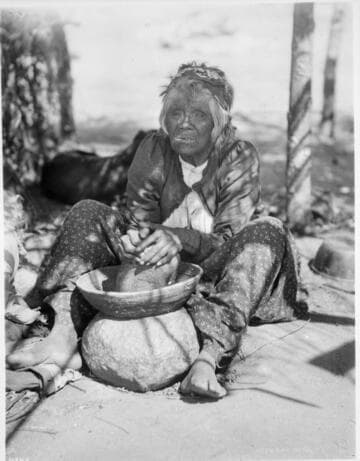
Cahuilla woman grinding acorns for flour
Visual Materials
A view of an old Indian woman seated with a rock between her legs. On the rock is a basket and she is grinding acorns into flour with a grinding stone.
photCL Pierce 01760
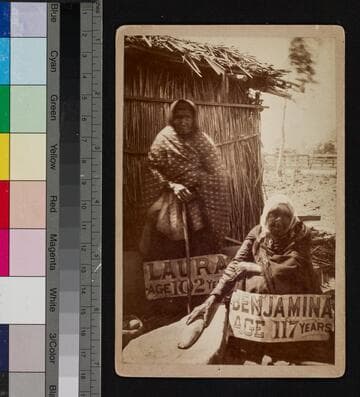
Indians at San Gabriel, Cal., 1883
Visual Materials
Two Indian women outside a brush dwelling. One woman holds a pestle on a stone mortar. The women have signs in front of them with the names Laura, age 102 years, and Benjamina, age 117 years.
photPF 20857

Interior of adobe house with dirt floor, built in 1845, still standing in San Juan Capistrano
Visual Materials
Interior view of adobe dwelling. Figure on cot in back of room.
photCL Pierce 03028
Image not available
Articles related to San Juan Capistrano and Valvaneda Aguilar
Visual Materials
The majority of the Ana Bégué de Packman collection consists of portraits of Southern California rancho families and their descendants, as well as photographs of the town of San Juan Capistrano and its environs, including Mission San Juan Capistrano and the adobe houses surrounding the mission. Also included are photographs, correspondence, maps, ephemera, and newspaper clippings related to Southern California ranchos and the Spanish-Mexican families who owned them, as well as Los Angeles during the late 1800s. Photographers include: Charles C. Pierce, Charles J. Prudhomme, Charles C. Puck, and Edward Vischer. A small number of the California rancho families are pictured in both professional and amateur portraits, with a focus on the Dominguez, Machado, Sepulveda, and Yorba families. Other portraits include those of Los Angeles mayors and pioneers, such as Matthew Keller, Cameron Erskine Thom, and Elijah H. Workman. Photographs of Mission San Juan Capistrano show the mission complex in ruins, with views of the church, courtyard, bell tower, and outside workspaces. The interior of the restored Serra Chapel are also shown, with an emphasis on the altarpiece and its statuary. Other missions that are shown in the collection are Missions Santa Barbara, San Antonio de Padua, and San Gabriel Arcangel. Another emphasized portion of the collection concerns adobe houses, specifically ones that are or had been located in the western and southern parts of San Juan Capistrano. Among these adobes are the Blas Aguilar Adobe, Casa de Los Rios, the Burruel Adobe, the Manuel Garcia Adobe, and the Domingo Yorba Adobe. Other Southern California adobes that are also included are the Yorba-Slaughter Adobe, the Dana Adobe, and the Workman-Temple Homestead. Oversized photographs show La Iglesia de Nuestra Señora Reina de Los Angeles (Plaza Church) and the statue of Felipe de Neve in Los Angeles Plaza. An interesting photograph of Plaza Church shows Don Antonio F. Coronel surveying the church exterior. Another photograph relating to the Los Angeles area is one of the Beverly Hills Centennial Parade with Eugene W. Biscailuz, Leo Carrillo, and William Boyd on horseback. Of particular interest are two tintypes related to photographer Charles J. Prudhomme. The first is of his mother, Maria Merced Tapia de Prudhomme, and the other is of Prudhomme's daughter. The rest of the collection contains correspondence, maps, notes, ephemera, and negatives. Noteworthy items from these materials include: a manuscript letter written by Manuel Dominguez; postcards from Bruce Condé (Alfonso de Bourbon Conde) to Ana Bégué de Packman; death notices for Isaac Williams and Henry Mellus; a glass plate negative of Horton House in San Diego; a film negative of Juan Bandini and his daughter Ysidora; and an index book with the names of rancho families written in Packman's hand. Photographs with corresponding film negatives are: (12), (26), and (29).
photCL 400 volume 33