Visual Materials
Ranch table with the Raymond Hotel in the distance
You might also be interested in
Image not available
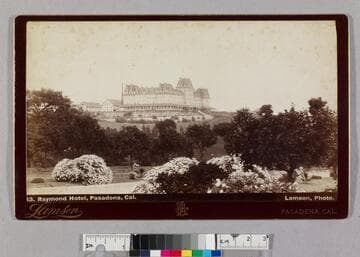
[Bird's eye view of Pasadena, California, looking towards the Raymond Hotel]
Visual Materials
Cabinet card with a bird's eye view of Pasadena, California, looking northeast with orange groves and houses in the foreground and the Raymond Hotel visible in the distance.
photPF 20814
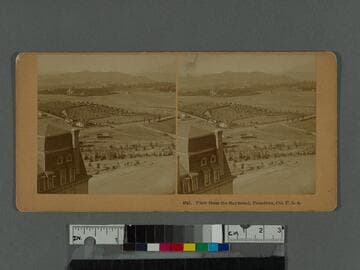
View from the Raymond, Pasadena, Cal. U.S.A
Visual Materials
Elevated view looking northwest over Pasadena, California, from the Raymond Hotel, with the dirt road of Fair Oaks Avenue running through the center and surrounded by fields.
photCL 555
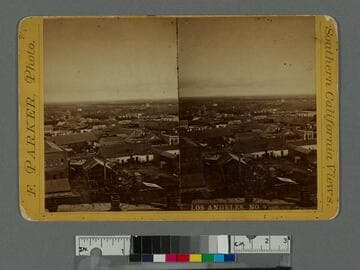
Los Angeles, No. 9
Visual Materials
Elevated view looking southeast over houses, back yards, and stores in downtown Los Angeles, California, with the Los Angeles and Independence Railroad depot (with two towers at San Pedro Street and Fourth Street) visible at far right in the distance and the tower of the Woodworth House at Second Street and San Pedro visible at middle left. Visible signs include "[?" R. Cameron," "Marble Works" (presumably in the 100 block of Main Street), and "Furniture."
photCL 555
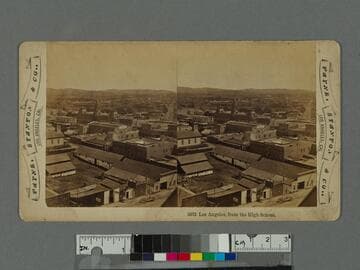
Los Angeles, from the High School
Visual Materials
View looking down from Los Angeles High School on Poundcake Hill towards commercial buildings in downtown Los Angeles, California. Buildings with visible signs include "Paint Shop," "Hotel Des Princes," and on North Main Street, the "Farmers and Merchants Bank" and Cosmopolitan Hotel," and "St. Charles Hotel." The Baker Block building, with tower, is visible.
photCL 555
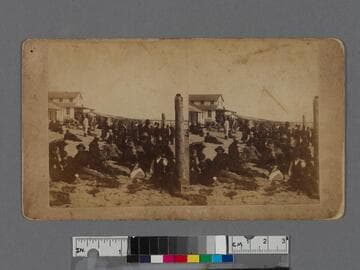
People on beach in front of the Santa Monica Bath House
Visual Materials
Image of people sitting on a beach wearing suit coats and hats in front of the Santa Monica Bath House in Santa Monica, California, with a portion of the Los Angeles and Independence Railroad Wharf visible in the distance.
photCL 555
Image not available
The Raymond, Pasadena, Ca. [exterior full view of Raymond Hotel] (Imprint no: 4341)
Visual Materials
This is a collection primarily of negatives and photographic prints depicting the growth of Santa Monica and Los Angeles, California, from 1860s to 1980s. Many views are cityscapes or street views, showing buildings, storefronts, homes and roads, and documenting the use of railroads, trolleys, streetcars, and automobiles. There are many card photographs by early professional photographers, and also a number of snapshots made by amateurs, some in personal photo albums. The collection's scope also includes early views of many other communities in Southern California (and a few in other states); the beginnings of aviation in Santa Monica, including the first Douglas Aircraft Company buildings; a photo album of residents in Topanga Canyon, ca. 1913; automobile racing in Los Angeles and Santa Monica, 1920s; maritime views; a photo album of U.S. troops in France during World War I; a 1949 real estate development in Apple Valley, California, and others. Besides photographs, a portion of the collection consists of scarce publications and historical ephemera, primarily related to Santa Monica and Los Angeles, including brochures, advertising cards, menus, event programs and other materials. Highlights of the Santa Monica images are aerial views of the buildings along the coast and pier (1920s); several views of the Arcadia Hotel (1880s); the Long Wharf and adjoining railroad and train depot; the first bath houses on the beach; the beach club culture of the 1920s and 1930s; the amusement piers of Santa Monica, Ocean Park and Venice; and the beginnings of the Douglas Aircraft Company. There is a large set of promotional photographs made late 1920s-1930s by Powell Press Service depicting people enjoying Santa Monica's beaches, clubs and outdoor recreation. An important subset within the collection is 407 negatives made ca. 1890 - 1908 by Los Angeles historian and amateur photographer George W. Hazard (1842-1914). Hazard travelled around Los Angeles and vicinity photographing the adobes, houses, streets and storefronts that told the early history of the city. Many of Hazard's negatives have handwritten identifications, naming streets, former homeowners, ranchos, and other historical details. There are a large number of cabinet cards and other card-mounted prints and stereographs. There are 1,264 stereograph prints, highlighted by the works of photographic pioneers William M. Godfrey, Francis Parker, Hayward & Muzzall, and Carleton Watkins. Other formats represented are: glass and film negatives; panoramic prints; 7 photograph albums, photographic postcards, 20th-century color prints and transparencies; and a small number of tintypes, cyanotypes and a set of chromolithographs.
photCL 555