Visual Materials
Fiesta de San Esteban, Acoma. Catching the bread

You might also be interested in
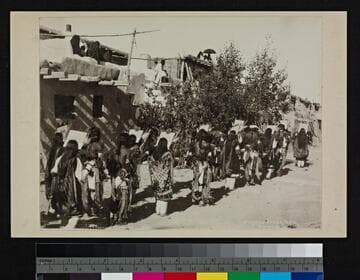
Feast of St Stephen, Acoma, N. M. 902
Visual Materials
Indian men and women gathered in the pueblo during the Feast of San Esteban (Saint Stephen), Acoma Pueblo, New Mexico.
photPF 2035
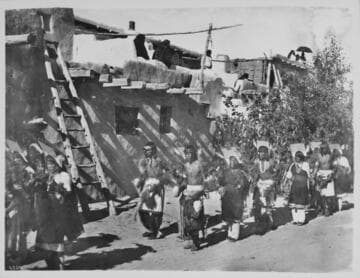
Fiesta de San Esteban. Religious dancers before the Kiva. Acoma
Visual Materials
A view of Acoma dancers in front of a kiva. There are onlookers on the roofs above the kiva and other houses.
photCL Pierce 01495
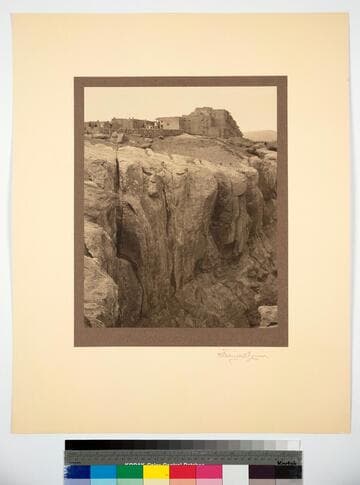
Acoma, New Mexico
Visual Materials
View of the cliff walls, trails and pueblo buildings, with several Indians gathered on top of the mesa.
photCL 312
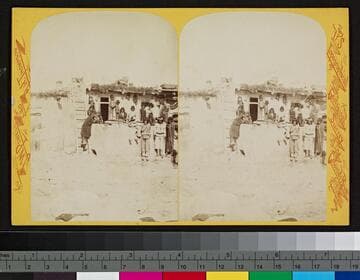
The Chief's House, in the Town of Oraibi
Visual Materials
Hopi Indians gathered in front of an adobe home in the pueblo of Oraibi.
photPF 3711
Image not available
Photographs of the American Southwest and Virginia
Visual Materials
Consists of 11 photographs. Five are snapshots of the Mission Santa Clara church building and items including a Latin liturgical text and chair. One of these is a photograph of a daguerreotype of the Mission prior to 1858. Three photographs, taken by George Wharton James were taken of Indigenous women at the Pueblo of Laguna, New Mexico, a procession for the Feast of St. Stephens at the Acoma Pueblo, New Mexico, and an indigenous man named Moki on his burro returning to his home in Walpi, Arizona. The remaining three photographs, taken in Virginia, are of the Petersburg Harbor, Virginia, a portrait of Richmond College President Frederic William Boatwright, and a candid snapshot of Robert Alonzo Brock, Jr. at Richmond College.
photPF 2030-2039
Image not available
James De Barth Shorb Papers
Manuscripts
The collection, which contains 10,844 items, consists of correspondence, letter books, manuscripts, speeches, diaries, account books, published articles, legal papers, financial statements and business records. The 10,528 pieces of correspondence are chiefly addressed to James De Barth Shorb, James M. Tiernan and Maria de Jesus Wilson Shorb. The 17 letter books are related to the business and financial affairs of Shorb and Benjamin Davis Wilson. The 75 manuscripts consist of items chiefly written by Shorb and Wilson family members. The 224 items in the Business Papers include material related to Shorb's many companies including the San Gabriel Wine Company. The following subjects are covered in the Shorb collection: the Shorb, Wilson, and Patton families, David Jacks, Mariano Vallejo, Santa Catalina Island, the Mount Wilson Observatory, California government and politics, African Americans and the Chinese in California, agriculture, the citrus fruit industry, Indians of California, irrigation, lend tenure, mining, railroads, ranching, water rights, and the wine industry. The collection also documents the history and development of the following California cities: Alhambra, Elsinore, Los Angeles, Pasadena, Ramona, San Gabriel, San Marino, and Wilmington. Notable authors include: Pelham Ames, Hubert Bancroft, Phineas Banning, Thomas Robert Bard, Charles F. Crocker, Ignacio Del Valle, Stephen Johnson Field, William McKendree Gwin, George Hearst, Isaias W. Hellman, Charles Webb Howard, O. Shafter Howard, Collis Huntington, Henry Huntington, Helen Hunt Jackson, Abbot Kinney, William Morrow, John Singleton Mosby, Francis G. Newlands, Harris Gray Otis, George Smith Patton, William T. Sherman, J. Campbell Shorb, Southern Pacific Company, Leland Stanford, Adlai Stevenson, George Stoneman, Harriet Strong, James M. Tiernan, Benjamin Truman, Stephen Mallory White, and Benjamin Davis Wilson. Correspondence The collection contains 10,528 pieces of correspondence. The majority of the correspondence is addressed to James De Barth Shorb, Maria de Jesus Wilson Shorb and James M. Tiernan. The correspondence covers the following subjects: Shorb's business affairs and land dealings in California and Arizona; the American Concentrated Must Company; the San Gabriel Wine Company and the wine industry; agriculture and the citrus industry; Shorb's political career; the Mount Wilson Observatory; the railroad in southern California; irrigation and water rights; Chinese, Japanese and African Americans in California; and the development of Elsinore, Santa Catalina Island, San Gabriel, Pasadena, Alhambra, Wilmington, and Ramona, California. The following individuals are also subjects in the correspondence: Ignacio Del Valle, George Hearst, Collis Huntington, Henry Huntington, David Jacks, George S. Patton, Leland Stanford, George Stoneman, Mariano Guadalupe Vallejo, and Benjamin Davis Wilson. Authors with 40 or more letters include (piece counts in parenthesis): James M. Allen (42), Pelham W. Ames (191), George Arbuthnot (49), Thomas Benton Bishop (50), William J. Brodrick (42), the California Board of State Viticultural Commissioners (158), William B. Carr (42), William Christy (54), Clark Churchill (125), Evan James Coleman (216), W. T. Coleman & Co. (179), J. W. Evans (79), Will S. Green (41), J. T. Harbert (40), Charles Webb Howard (94), O. Shafter Howard (43), John C. Kirkpatrick (56), Lusk & Co. (55), Leroy E. Mosher (54), W. J. Murphy (45), Francis G. Newlands (83), Paul Oeker (336), George S. Patton (40), Gervaise Purcell (59), John C. Quinn (58), Erskine Mayo Ross (58), James De Barth Shorb (280), Southern Pacific Company (58), Stanley's Sons (63), Edward Lancaster Watkins (83), Stephen Mallory White (56), Lewis P. Wiel (44), Benjamin Davis Wilson (86), Frederick W. Wood (177), and Edward T. Wright (48). Other notable authors include: Hubert Howe Bancroft, Phineas Banning, Thomas Robert Bard, Grover Cleveland, Antonio Franco Coronel, Charles F. Crocker, Ignacio Del Valle, John Downey, Stephen Johnson Field, Mary Foy, William McKendree Gwin, George Hearst, William Randolph Hearst, Isaias W. Hellman, The History Company, Henry Huntington, Helen Hunt Jackson, John P. Jones, Abbott Kinney, William Morrow, John Singleton Mosby, Charles Nordhoff, Harrison Gray Otis, Theodore Roosevelt, Saint Elizabeth Ann Seton, William Tecumseh Sherman, Leland Stanford, Adlai Stevenson, George Stoneman, Harriet Strong, William Howard Taft, James M. Tiernan, Benjamin Truman, Wells, Fargo & Company, Charles Wetmore and Clarence Wetmore. The section entitled Correspondence, Post 1917 (which contains 440 items) consists of correspondence chiefly addressed to Shorb's daughter Ethel Rebecca Shorb. These letters deal with the Shorb family from 1917 to 1957. The group contains a large run of love letters to Ethel from a man named John Gaylord Church. Letter Books The 17 letter books concern the business and financial affairs of James De Barth Shorb, Benjamin Davis Wilson, and B. D. Wilson & Co. Their inclusive dates are 1870-1894. Manuscripts The 75 manuscripts consist of notes, speeches, diaries, account books, and drafts and copies of published articles and manuscripts. The majority of the authors are Wilson and Shorb family members. This group contains several manuscripts by Benjamin Davis Wilson including "The Indians of Southern California: Report to the Superintendent of Indian Affairs" and several copies and drafts of his "Observations on Early Days in California and New Mexico." Subjects covered in the manuscripts are: early California history; Shorb, Wilson, and Patton family history; California government and politics; Helen Hunt Jackson and Ramona; irrigation; agriculture; and land ownership. This group also includes a diagram of the Battle of Gainesville drawn by John Singleton Mosby in 1891. Business Papers The 224 items in the Business Papers consist of reports, notes, legal papers, by-laws and articles of incorporation, financial statements, record and account books, stock certificates, and agreements. The business papers deal with the financial and business affairs of James De Barth Shorb and Benjamin Davis Wilson and include material related to mining in California, Colorado, and South Dakota; Los Angeles politics; water and irrigation; and the wine industry. Authors include the following companies: Arizona Improvement Company, San Marino Mill and Mining Co., Alhambra Addition Water Company, Lake Vineyard Land and Water Association, San Gabriel Water Company, La Sierra Water Company, B. D. Wilson & Co., American Concentrated Must Co., and the San Gabriel Wine Company.
mssShorb papers